How to analyze NPS without reducing Voice of the Customer to a score
Key takeaways
- NPS sorts customers into promoters, passives, and detractors from a single question, but its calculation says nothing about what's actually driving it.
- The limits of the score show up as soon as you use it alone: without the verbatims attached, an NPS can't diagnose a problem or prioritize an action.
- Identifying the root causes behind each rating is what turns a tracking indicator into a decision lever for CX, product, and Customer Success teams.
- An expert VoC AI like Glanceable connects the score to the customer signals that explain it, so every shift in your NPS becomes an action assigned to your teams, not just a comment in a meeting.
Summarize this article with:
NPS (Net Promoter Score) answers a simple question: would you recommend this company to someone close to you? But interpreting it is rarely simple. A score that climbs three points can mask a drop in satisfaction across an entire customer segment. A stable score can hide a pain point building on a specific channel. Analyzing NPS correctly means never reading it alone: it has to be cross-referenced systematically with the verbatims that explain it, or the number stays a photograph without a caption.
This is exactly the trap that catches most organizations that have adopted NPS: the score becomes a line in a monthly dashboard, discussed in a meeting, without ever making its way down to the teams that could act on what's driving it. But an indicator that triggers no action is no longer a management tool: it's a thermometer you glance at without ever opening the window. Understanding NPS in depth is therefore as much a question of calculation method as of organizational discipline: who, on your teams, gets the alert when the score drops on a segment, who is responsible for digging into the cause, and who decides what action to take. The cost of getting this wrong is rarely visible in the short term, which is precisely what makes it dangerous: a poorly interpreted NPS quietly erodes loyalty for months before the consequences show up in churn or renewal figures.
NPS: definition, calculation and limits to know
The Net Promoter Score rests on a single question, typically asked on a 0 to 10 scale: how likely are you to recommend this company to a friend or colleague? This apparent simplicity largely explains its massive adoption since it was introduced by Fred Reichheld in the Harvard Business Review: one question, a score that's easy to communicate, and comparability over time and across teams. But this surface-level simplicity hides a calculation mechanism you need to understand precisely before steering anything off this number.
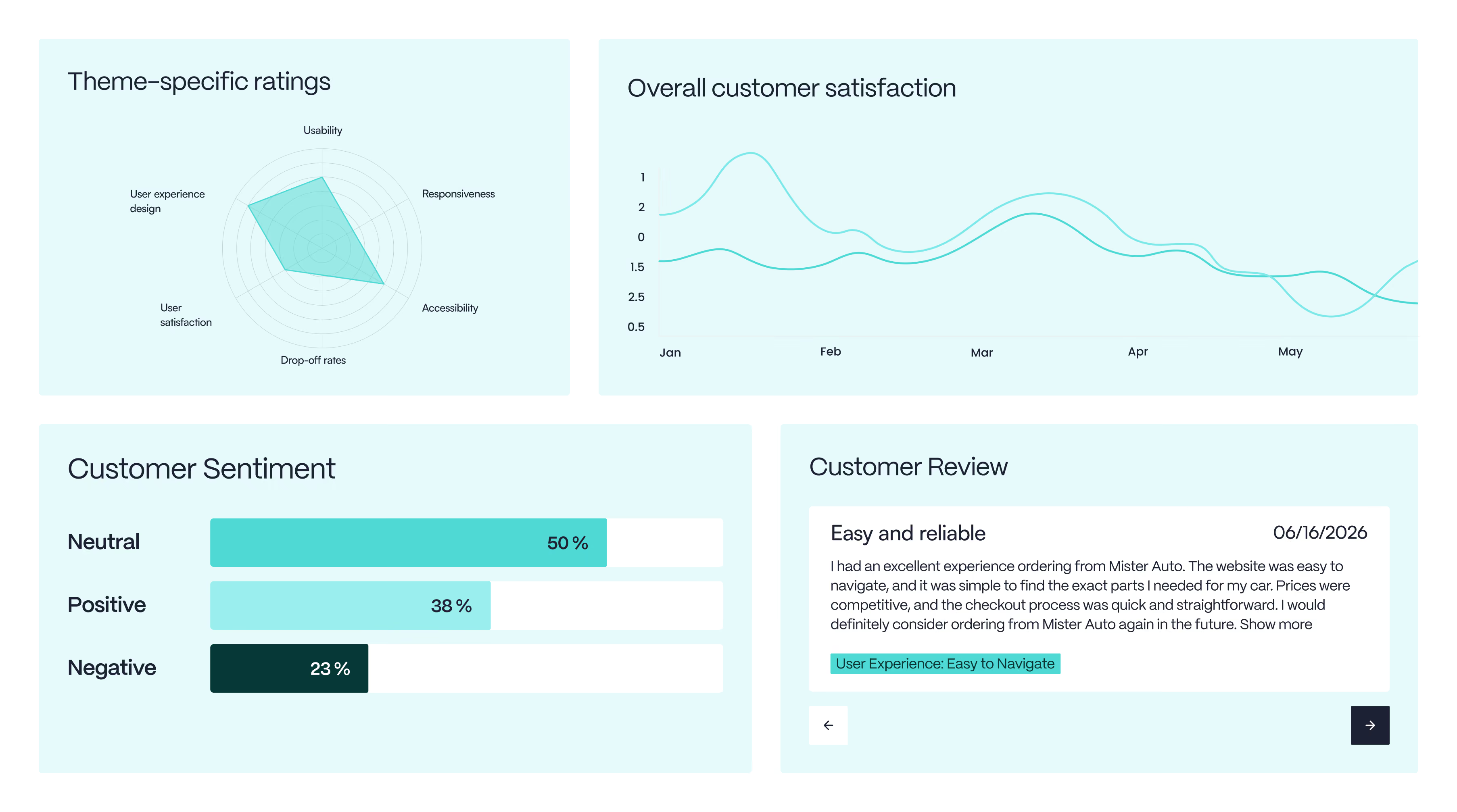
The intuition behind NPS wasn't to invent yet another satisfaction indicator, but to replace long, underused surveys with a single question whose answer genuinely commits the customer: recommending a company means putting your own credibility on the line with people you know. This intention to recommend, rather than simple declared satisfaction, is what gives NPS its predictive value for future customer loyalty. This engagement dimension is what sets NPS apart from a plain, one-off satisfaction score, and explains why, more than twenty years after it was created, it remains one of the most closely tracked loyalty indicators, provided you don't stop at the number alone.
Promoters, passives and detractors
The calculation of NPS splits respondents into three categories based on the rating they give:
The final score is obtained by subtracting the percentage of detractors from the percentage of promoters, with passives left out of the direct calculation but still a population worth watching closely: a passive can turn into a promoter after one standout positive experience, or slide into detractor status at the next added irritant. This volatility makes passives a strategic segment in their own right, often overlooked in favor of the two categories that directly weigh on the score. The official Net Promoter System framework makes clear that the method's value doesn't come from the isolated score, but from the organizational discipline built around it: collecting the feedback, sharing it quickly with the teams concerned, and acting on it systematically.
What the score doesn't tell you alone
This is where the main limits of the score show up: an NPS of 35 reveals neither the journey at fault, nor the channel involved, nor the part of the experience that pushed a rating from 9 down to 6. Two companies can post an identical NPS while facing radically different structural problems: one struggling with a failing after-sales service, the other with an unreliable delivery process. Without the associated verbatims, these two realities are indistinguishable in the number alone. That's why understanding the customer insights that come with every rating is the condition for turning a tracking score into a genuine tool for managing the experience.
This limit also explains why comparing your NPS to other industries, or even other companies in your own industry, should always be done with caution. Rating habits vary by market and culture: a customer can be structurally more generous or more severe in how they rate, depending on the country they respond from, regardless of the actual quality of the experience lived. An NPS is only reliably meaningful when tracked over time for the same population, or compared against benchmarks from the same industry and the same geographic zone, never as a universal absolute value that would let you rank companies against each other without nuance.
How to interpret the verbatims linked to NPS?
An NPS score without a verbatim is a rating without an explanation. The real value of the exercise appears once you systematically connect every numeric rating to the free-text comment that comes with it: this combined reading is what turns a reporting figure into a signal teams can act on. It's also what distinguishes an organization that endures its NPS results from one that actively steers them: the first waits for the next survey wave to notice a change, the second has already spotted, along the way, the weak signals announcing that shift in score.
Identifying the root causes behind a score
A customer who gives a 6 after waiting through three follow-ups to get an answer isn't expressing the same problem as a customer who gives a 6 because the price feels high compared to the competition. Identifying the root causes behind each rating means going beyond the promoter/passive/detractor classification to look at what the customer actually described: a one-off irritant, a structural flaw in the journey, or an unmet expectation on a specific point of the product or service. An AI-powered analysis of customer feedback makes it possible to automatically group verbatims by recurring theme, where a manual reading, verbatim by verbatim, quickly hits its limits once response volume passes a few hundred per month.
This is also the step where the difference between a generic AI and an expert VoC AI is felt most: a summary produced by a generalist assistant often stops at a surface-level synthesis, whereas a reading built for Voice of the Customer goes as far as isolating the precise root cause and linking it to a volume of affected customers.
In practice, the exercise means never settling for the first explanation that comes along. A verbatim mentioning "slow customer service" can cover several quite different realities: a phone wait time judged too long, an unanswered email response deadline, or a string of different agents that forces the customer to repeat their request at every contact. These three root causes call for entirely different operational responses: resizing the team, revising processing deadlines, or redesigning the handoff process between departments. Grouping these verbatims under one generic label would mean treating a symptom without ever addressing the cause producing it.
Segmenting signals by journey and persona
A global NPS masks very different realities depending on the segment observed. Segmenting signals by journey (purchase, onboarding, support, renewal) and by persona (new customer, long-standing customer, key account, individual) makes it possible to spot pain points that would otherwise stay invisible, buried in an overall average. A score that's stable at the company level can hide a sharp NPS drop on the onboarding journey of one specific segment, a drop that calls for immediate action even though it appears nowhere in the consolidated figure. Voice of the Customer and AI make it possible to cross-reference these dimensions without multiplying manual pivot tables, keeping the context of each verbatim in place at the moment it's aggregated.
This segmentation work becomes even more decisive as an organization grows or diversifies its offer. A key account and an individual customer don't hold the same expectations toward the same product: the first often values the responsiveness of a dedicated contact and the clarity of contractual commitments, the second is more sensitive to day-to-day ease of use and the speed of self-service resolution. Managing a single NPS without distinguishing these two populations means applying the same corrective actions to fundamentally different expectations, with a real risk of satisfying one segment while degrading the other's experience. The same logic applies across geographies for organizations operating in several countries: a rating habit that looks like dissatisfaction in one market can be an entirely normal baseline in another, so segmentation by geography deserves the same discipline as segmentation by journey or persona.
What business uses for CX and Customer Success teams?
NPS only has value if it triggers action on the business side. That's where your CX, Customer Success, product, and operations teams come in: they're the ones who turn a score and its associated verbatims into a concrete decision. AI agents in customer relations play a growing role in this chain, speeding up the flow of signals to the right teams without waiting for the next monthly meeting.
Too often, NPS stays the exclusive property of the CX or marketing leadership, who present it in a meeting without any operational team feeling genuinely responsible for moving it forward. This lack of shared accountability is one of the main reasons your score can stagnate for several consecutive quarters, despite visible leadership effort: without a concrete relay to the teams touching the customer journey day to day, none of the identified root causes translates into a real change in the experience your customers live.
From score to action plan assigned to the right team
In practice, every type of identified pain point points to a different team:
This breakdown by team is what avoids the classic pitfall of an NPS managed "in a silo": a score followed only by CX leadership, with no relay to the teams that can actually act on the identified causes. The role of a VoC platform is precisely to streamline this prioritization and this action, assigning each insight to the team best placed to handle it, with tracking of the resolution over time.
For Customer Success teams in particular, this reading changes the nature of day-to-day work: rather than discovering an unhappy customer at renewal time, the team can step in upstream, as soon as a first negative signal appears on a high-stakes account. For marketing, an NPS segmented by acquisition campaign or by offer helps identify whether a commercial promise is creating expectations the actual experience doesn't later deliver on: a gap between promise and lived experience that, left uncorrected, mechanically feeds future detractors. For operations, connecting NPS to logistics incidents (delivery delay, stock shortage, order error) helps prioritize investment in the links of the chain that weigh most on the customer's overall perception, rather than spreading effort evenly across the whole journey.
Keeping humans in the loop on brand-defining decisions
On high-stakes decisions (a journey redesign, a change to the refund policy, a public statement responding to a score drop), AI should remain a decision aid, not an autonomous decision-maker. This is the human in the loop principle: the AI builds the case, aggregates the verbatims, quantifies the potential impact, and proposes a prioritization, but it's the teams who decide what's at stake for the brand in front of customers, regulators, or public opinion. This approach is what sets a feedback intelligence practice (the methodical, governed use of customer feedback) apart from blind automation that would trigger actions on sensitive topics without human validation. AI's role is therefore never to replace business judgment, but to feed it with a fuller, faster reading of the available signals, so that the final human decision rests on verified facts rather than an impression shaped by informal reports over time.
In practice, this means AI can, for example, detect a sudden rise in detractors linked to a new billing policy, precisely quantify its scale and the segment concerned, and propose an immediate escalation to the relevant teams. But the decision to reverse that policy, to communicate publicly about it, or to offer a commercial gesture to affected customers, remains a human decision, made with full knowledge thanks to a case already built, not an action triggered automatically based on a statistical threshold.
How to prioritize actions after an NPS drop or increase?
A shift in NPS, whether up or down, should always trigger the same question: what is the real business impact of what has just been observed? Without this step, the organization risks spending time and budget on frequent but low-cost pain points, while letting rarer but far more damaging problems slip through, at real cost to loyalty and retention.
Linking each pain point to a measurable impact
A pain point mentioned three times in the verbatims can weigh more heavily on churn than one mentioned fifty times, if it touches a high-value customer segment or occurs at a critical moment in the journey (just before a renewal, for example). That's why prioritization should never rest on how often a pain point appears in the verbatims alone: it has to be cross-referenced with your behavioral data (churn, repeat purchase, value of the segment concerned) to build an order of treatment based on real impact, not just complaint volume. A VoC platform that natively connects verbatims to your CRM and product data enables this perspective, where an isolated reading of customer comments alone cannot.
This logic ties into a broader observation about the economics of customer loyalty: according to the work of Bain & Company on the economics of loyalty, a customer's value is never limited to their immediate transaction: it's measured over the length of the relationship, purchase frequency, and margin generated over time. A pain point that touches customers with strong retention value therefore deserves priority treatment, even if it represents only a fraction of the total volume of negative verbatims. Prioritizing by impact rather than frequency is also what keeps the continuous-improvement budget from drifting toward the most visible topics in a meeting rather than the ones that genuinely weigh on growth.
Distinguishing corrective action from product opportunity
Not every NPS drop calls for the same type of response. Some reveal a one-off irritant to fix quickly: a bug, an abnormal delay, a communication error. Others reveal, underneath, a more structural product opportunity: a feature expected by a growing share of customers, a usage shift the current product doesn't yet cover. Confusing the two leads either to overreacting to a marginal irritant, or to underinvesting in a product evolution that could, over time, turn passives into promoters. A frequent example: the same keyword, "slow," can cover an interface issue fixable in a few days, or a structural limit of the product architecture that requires several months of work; two radically different responses that only a close reading of the root cause can distinguish before committing resources. The distinction comes from watching the signal's recurrence over time: a one-off irritant fades once fixed, while an underlying trend keeps growing as long as the product doesn't evolve.
This long-view reading is what allows a calm arbitration between urgency and product strategy. An isolated spike of negative verbatims in a single week, linked for instance to a one-off technical incident, calls for a fast, contained response. A trend that settles in over several consecutive months, on the other hand, deserves to be escalated to the product committee as a strategic signal, with an investment sized to match the stakes, rather than handled at the same level as a minor fix.
What role for Glanceable in more reliable NPS management?
Managing NPS at an organization's scale means handling a volume of verbatims that manual methods can no longer absorb beyond a few hundred monthly responses. This is where an expert VoC AI like Glanceable comes in: it doesn't just automate the sorting of your comments, it acts as a trusted third party over your customer data, ensuring that every score and every identified cause stays traceable and verifiable, so the decisions you make from these analyses remain defensible in front of leadership or a client.

Adapting NPS management to automotive journeys
In the automotive sector, NPS is measured across multiple journeys, sometimes far apart in time: vehicle purchase, a visit to the dealership for maintenance, contact with after-sales service, the distribution network experience depending on the market. These journeys don't share the same frequency or the same stakes: a poor purchase experience doesn't weigh the same on loyalty as a recurring bad maintenance experience, which sits inside a relationship meant to last several years. A VoC for automotive makes it possible to track these journeys separately rather than folding them into a single score that would mask the gaps between a well-performing network and a struggling one in a given market, all while keeping a consistent multilingual reading across the countries covered, a particularly sensitive point for manufacturers and distributors present across several European markets at once. It also makes it easier to compare dealership performance on a like-for-like basis, rather than penalizing a network simply because its local customer base rates more critically on average.
Prioritizing signals in a retail environment
In retail, the volume of customer feedback is often massive and scattered across public reviews, post-purchase surveys, and customer service exchanges. A VoC for retail helps prioritize the signals that genuinely weigh on repeat purchase (a delivery pain point, for example, rather than a single isolated comment on packaging aesthetics), so teams focus on what has a measurable impact on loyalty rather than what generates the most noise.
This retail context illustrates well why segmentation by journey is essential to NPS management: a customer rating their experience after an in-store purchase doesn't react to the same pain points as a customer who orders online and gets delivered at home. Folding these two journeys into a single NPS amounts to averaging two distinct operational realities: in-store welcome on one side, logistics reliability on the other, and losing, in that average, the ability to know where to invest first.
A 100% VoC expert AI, not a ChatGPT wrapper
One point deserves clarifying: an expert VoC AI like Glanceable is not a layer built on top of a general-purpose conversational assistant applied to customer feedback. It's a proprietary AI, designed specifically for classifying, prioritizing, and tracking customer signals, with data governance built for this exact use case: traceability of classifications, native GDPR compliance, hosting suited to the requirements of regulated industries. This specialization concretely changes the nature of the result: where a generic summary stops at a surface-level synthesis, an expert VoC AI links every insight to a verifiable root cause, a volume of affected customers, and a prioritized decision for the team that needs to act.
This difference shows up especially over time. A one-off summary generated on demand builds no memory of the topic: every analysis starts from zero, with no link to the trends observed the previous month. A platform built for Voice of the Customer, by contrast, keeps track of how a pain point evolves over time (its frequency, the segments it touches, the actions already taken to fix it), which makes it possible to actually verify whether an action worked rather than relying on an impression. This end-to-end traceability, from the raw verbatim through to the decision made in a meeting, is what sets a feedback intelligence practice apart from a simple monthly reporting exercise.
Ready to connect your NPS to the causes that really explain it?

Ultimately, NPS is neither an indicator to ignore nor a number to follow blindly: it's an entry point into a finer reading of the customer experience, provided you always connect it to the verbatims, the root causes, and the decisions it should trigger. The organizations that extract the most value from it are the ones that have built this complete, repeatable chain: from the rating to the verbatim, from the verbatim to the cause, from the cause to the team that acts, rather than those that settle for commenting on a number in a meeting without ever tracing it back to what actually explains it.
This methodological rigor isn't excessive theoretical discipline: it's what separates, in practice, organizations where NPS improves durably from those where it stagnates year after year despite visible effort. The difference is almost never down to the measurement tool chosen, but to your organization's ability to turn every shift in the score into a complete chain of understanding and action, carried by teams that know precisely what they need to fix and why. It's this discipline, repeated rating after rating, that drives lasting NPS improvement, far more than any one-off adjustment to the measurement setup.
External sources cited: Fred Reichheld, "The One Number You Need to Grow," Harvard Business Review, 2003; Bain & Company, Net Promoter System framework; Bain & Company, the economics of customer loyalty.
FAQ
The calculation of NPS is obtained by subtracting the percentage of detractor customers (rating of 0 to 6) from the percentage of promoter customers (rating of 9 or 10), with passive customers (rating of 7 or 8) left out of the calculation but still worth watching. As a methodological illustration only (not as numerical proof drawn from a real client case), if a clear majority of respondents fall into the promoters and only a minority fall into detractors, the resulting score will be positive, and higher still the wider the gap between the two categories; conversely, as soon as detractors outnumber promoters, the score turns negative, regardless of how many passives are in the sample. To be usable, this number should always be read as a trend over time and by segment, never as an isolated absolute value from a single period, and always alongside a large enough respondent volume so the shift observed isn't simply the result of chance in a small sample.
Because the score alone reveals neither the journey involved, nor the channel, nor the cause behind the rating given. Two organizations posting the same NPS can be facing entirely different structural problems: one suffering from a failing after-sales service, the other from a perceived pricing issue. Systematically cross-referencing the score with its associated verbatims makes it possible to identify the real root causes behind every shift in the number, and avoids steering an organization off an indicator that, alone, says nothing about the experience customers actually live or which teams need to be mobilized to address it. This systematic cross-referencing, more than the choice of any particular rating scale or survey tool, is what makes the difference between an NPS that genuinely guides decisions and one that just feeds a dashboard.
By linking every identified pain point to a measurable business impact (churn, repeat purchase, segment value), then assigning the corrective action or product evolution to the team best placed to handle it (CX, Customer Success, product, marketing, or operations), with resolution tracked over time and a check that the action actually moved the signal that caused the problem in the first place. It's this complete chain, from measurement to decision to tracked action, that sets a managed NPS apart from an NPS that's merely observed from one meeting to the next, without ever coming back to verify whether the decisions made produced the expected effect.
Articles you might be interested in
Data alone rarely drives action, but a well-told story does. Discover why design-driven storytelling is essential to Voice of the Customer analysis, and how a human-centered approach turns weak signals into decisions your teams actually act on.
Voice of Customer isn't just a collection of reviews: it's connecting customer signals to business decisions to turn every piece of feedback into an assigned action, rather than just a line in a report.