Glanceable or Goodays: what is the difference for analyzing your customer feedback?
Goodays and Glanceable both help retailers make use of their customer feedback. Goodays is the best fit to collect reviews, get frontline teams to respond and look after your Google rating. Glanceable is a better fit to analyze all sources with a single plan and automate business processes.
Summarize this comparison with:
How do Glanceable and Goodays compare, criterion by criterion?
The table uses the criteria CX buyers raise in demos. Each cell describes what the vendor publishes, with no rating or score.
| Criterion | Glanceable | Goodays | Question to ask in the demo |
|---|---|---|---|
| A. What data the tool analyzes | |||
| Sources analyzed | Surveys, public reviews, tickets, emails, chats, WhatsApp, call transcripts, social media | Questionnaires on more than 20 collection channels (stores, website, customer service, email), Google reviews | Do you analyze surveys, reviews, tickets, chats and calls in one tool, with the same classification plan? |
| Customer service conversations | Journey of each conversation between customer, chatbot and agent: intent, action, outcome (resolved or not) | Satisfaction measured after a customer service contact, by questionnaire | Can we see at which step a conversation fails, between chatbot and agent? |
| Review and survey collection | Analysis of the surveys and reviews collected by your existing tools | Core of the platform: questionnaires designed for conversion (96% announced), redirection to Google | Do you provide your own questionnaires, or analyze those from our current tools? |
| B. Analysis quality | |||
| Classification plan | Your plan and the one suggested by the AI, side by side; models trained on your labels | Sentiment analysis; AI assistant that summarizes reviews and identifies the main pain points | Can we keep our own plan, have several, and does the AI learn from our corrections? |
| Reliability and control | 100% of verbatims classified; each theme links to its verbatims, each classification can be corrected | Reviews viewable behind each indicator, in one click | Can we trace each theme back to the source verbatims and correct a classification? |
| C. Taking action | |||
| Prioritization | Themes weighted by their impact on NPS | Impact drivers on NPS and estimated potential gain of each action plan | Do you prioritize by volume, or by impact on NPS? |
| Frontline team engagement | Reports and dashboards by scope (store, region, head office) | Team responses to reviews, assisted by AI; real-time dissatisfaction alerts; Customer Relationship score | Can frontline teams reply to customers from the tool? |
| Business process automation | Workflows designed with Glanceable engineers on the customer's cases, with human validation (e.g. seller risk at Fnac Darty) | Dissatisfaction alerts and team responses, day to day | Can you automate one of our business processes, and who builds it? |
| Online reputation | Analysis of Google and Trustpilot reviews with your other sources | Tracking of the network's Google listings, redirection of satisfied customers to Google, local competitive benchmark | Do you track our Google listings store by store? |
| D. Implementation | |||
| Integrations | Sources connected by API in a few days; file import | API to CRM, marketing tools, customer service and messaging | Which connectors exist for our tools? What needs to be developed? |
| Getting started and support | Classification plan up and running in a few days; average deployment in less than a month | Multidisciplinary teams: program scoping, team training, configuration, post-launch follow-up | How long between signing and the first analyses on our data? |
| Security | Google Cloud in Europe, GDPR, SOC 2 Type 2 report | Encryption, strict access control, strong authentication, security policies | Where is the data hosted? Which certifications and audit reports? |
| E. Cost | |||
| Pricing model | Essential €19,000 excl. VAT per year, Business €38,400 excl. VAT per year, Enterprise on quote | On quote | Does the price depend on volume, sources or users? What is included? |
Public prices excluding VAT. Has something changed? Write to us from the Contact page.
What does each platform cover, from collection to action?
Goodays presents itself as a customer experience management platform, adopted by more than 150 companies. It covers review collection on more than 20 channels, customer responses by frontline teams, indicator analysis and Google online reputation.
Glanceable is an AI Voice of the Customer platform focused on analysis and action. It analyzes the feedback already collected by your tools, Goodays included, then turns it into alerts, reports and business workflows.
Which customer feedback sources are analyzed?
Goodays centralizes Google reviews and responses to its questionnaires, deployed in store, on the web and after a customer service contact. Glanceable analyzes surveys, public reviews, tickets, emails, chats, WhatsApp and call transcripts, with a single classification plan.
How does each tool help prioritize?
Goodays identifies the drivers that weigh most on NPS and estimates the potential gain of an action plan. Glanceable weights each theme by its impact on NPS, and each figure links to the verbatims behind it.
How do the pricing models compare?
Goodays is on quote. Glanceable sells annual packs, setup and onboarding included. Essential costs €19,000 excl. VAT (50,000 verbatims, 2 sources, 5 users). Business costs €38,400 excl. VAT (100,000 verbatims, 5 sources, 20 users), Enterprise is on quote.
What support is provided?
Goodays highlights multidisciplinary teams that support the program before, during and after launch. Glanceable includes setup, onboarding and a dedicated Customer Success Manager, with a classification plan up and running in a few days.
Where do Goodays and Glanceable meet?
On these features, both platforms meet the same need. The choice is made elsewhere.
- tracking NPS and the drivers that make it vary;
- sentiment analysis and AI assistant to summarize pain points;
- alerts to handle dissatisfaction quickly;
- dashboards by scope, from store to head office;
- references in mass retail, fashion and banking;
- API connection to the CRM and customer service tools.
What does Glanceable focus on?
Three points shape the projects where Glanceable is chosen alongside or instead of Goodays.
A single classification plan for all your sources
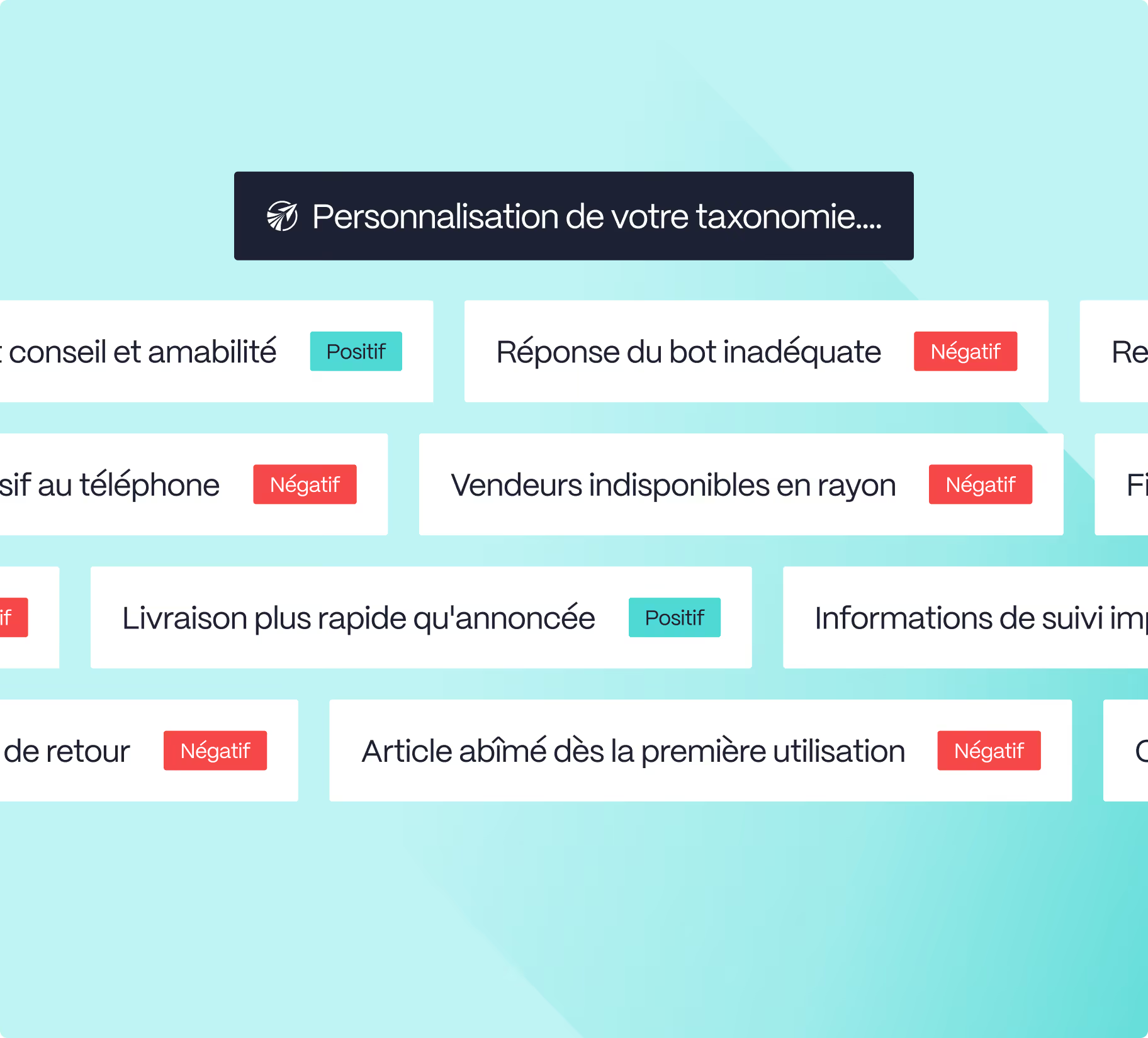
Glanceable classifies each verbatim with your business vocabulary. You keep your plan, the AI suggests one alongside it, and models learn your labels. Responses to your Goodays questionnaires are classified in the same plan as your tickets, chats and calls.
→ See the classification plan in the platform
The journey of each conversation, between chatbot, agent and customer
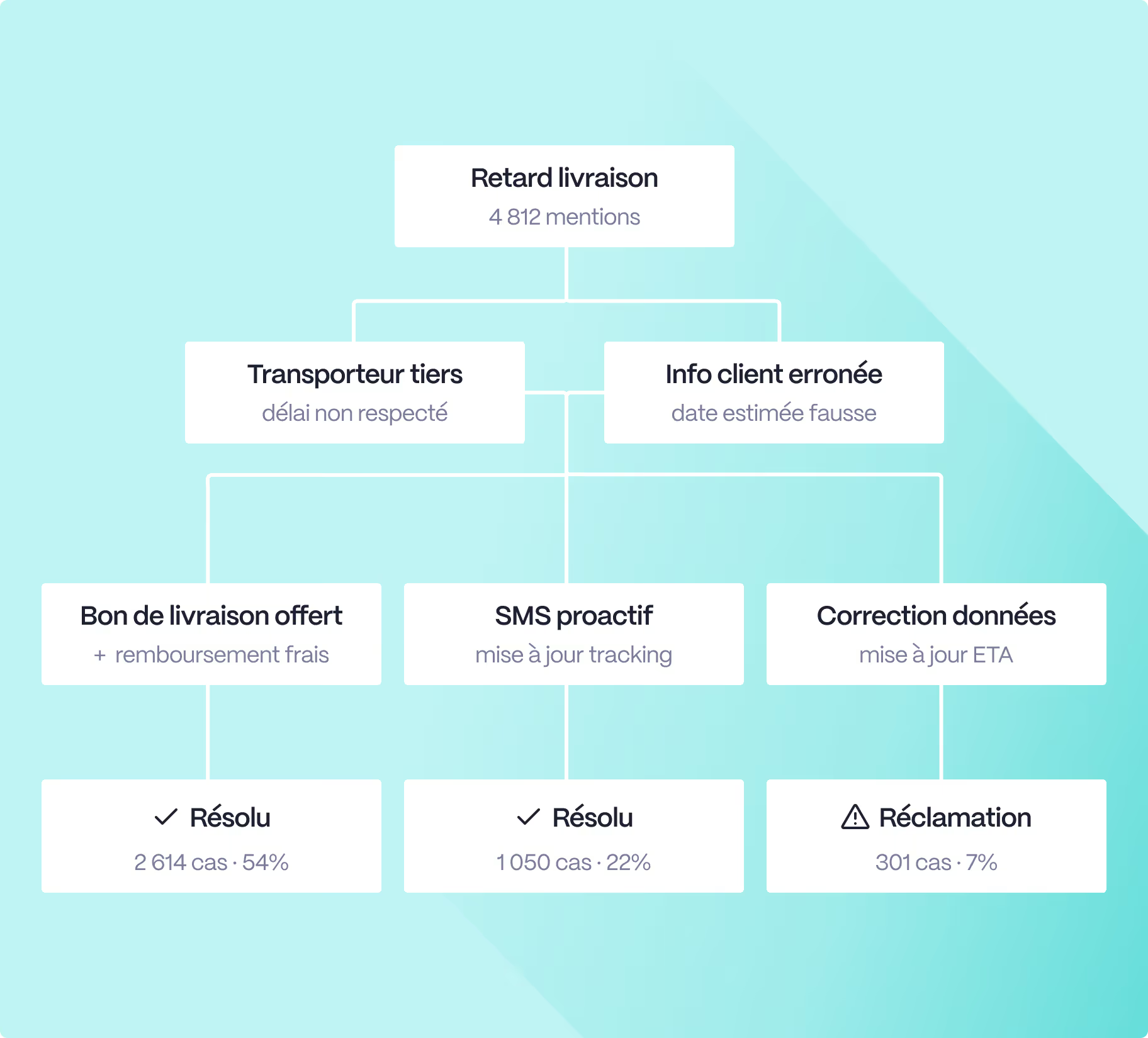
For each call, chat or WhatsApp conversation, Glanceable rebuilds the journey between the customer, the chatbot and the agent. Each step carries the intent, the bot's or agent's action and the outcome: resolved, unresolved, satisfied.
Glanceable thus shows where a conversation breaks down between the chatbot and the agent, for each contact reason. Club Med uses it to spot the requests its chatbot does not resolve and to enrich its knowledge base.
Business workflows built with our engineers
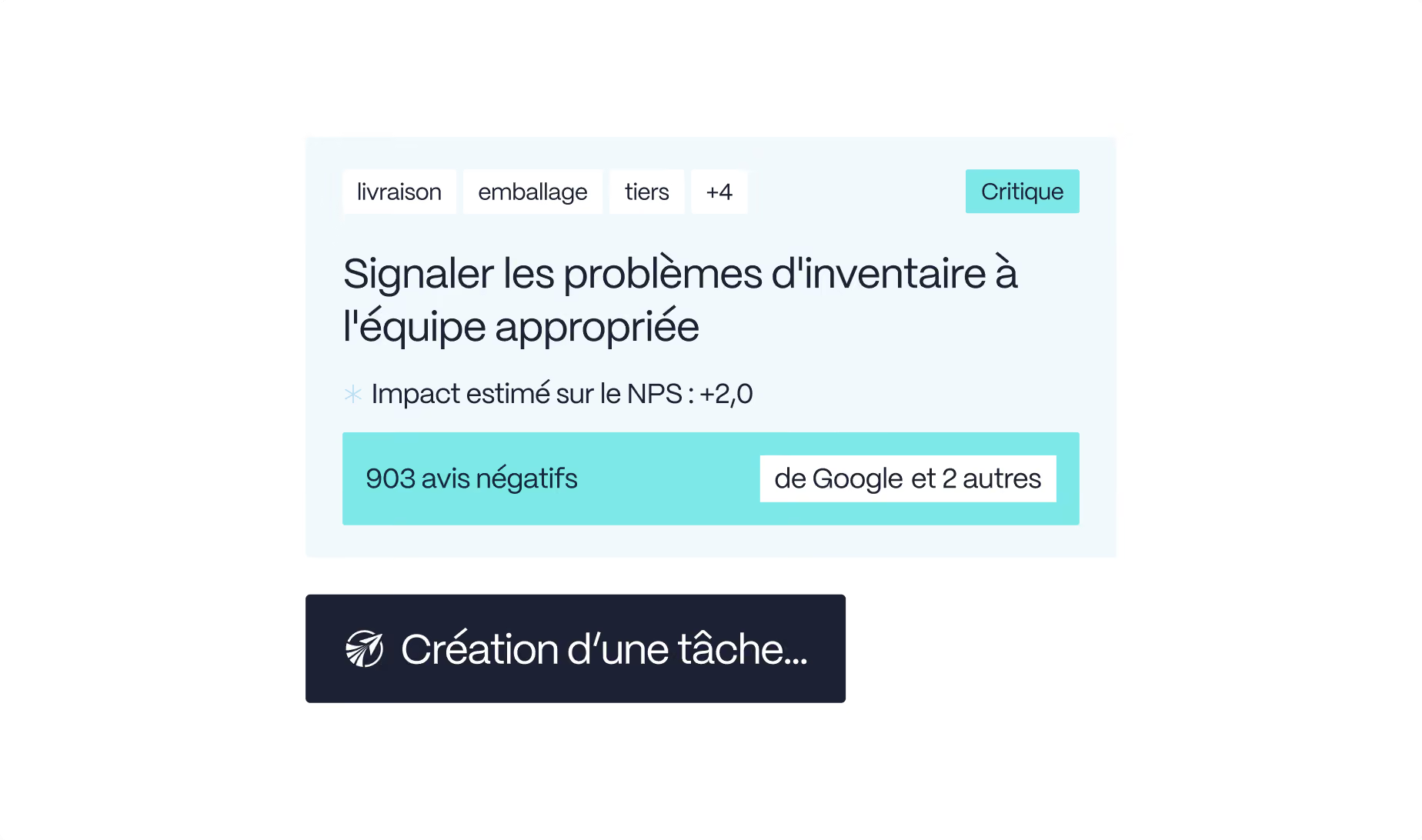
Glanceable designs automated workflows with the customer on its own use cases. Glanceable engineers integrate them into its tools: CRM, survey tool, internal database.
The workflow detects cases and ranks them as critical, medium or low alerts. The customer approves, rejects or lets it run automatically. At Fnac Darty, six AI agents assess the risk of every marketplace seller each day.
→ Read the Fnac Darty case study
Goodays, Glanceable, or both?
For a network that wants to collect reviews, get its frontline teams to respond and look after its Google rating, Goodays is the best fit. For a large company that wants to understand where its customer conversations break down and automate business processes, Glanceable is a better fit. The two can work together.
Choose Goodays if…
- you want to collect reviews in store, online and after a customer service contact
- your frontline teams need to respond to reviews and track their rating day to day
- your network's online reputation on Google is a priority
Choose Glanceable if…
- you want to analyze all your feedback, Goodays responses included, with your own classification plan
- you want to track your customer conversations between chatbot, agent and customer
- you want to automate a business process with dedicated engineers
What results does Glanceable achieve at a large retail company?
On its marketplace, Fnac Darty uses Glanceable to analyze NPS verbatims, seller reviews and 600,000 conversations a month, with no sampling. Complaints were divided by 4 and marketplace NPS doubled.
Fnac Darty: complaints divided by 4 and marketplace NPS doubled
AI builds the case, a person decides: every seller suspension is still validated by a human during a weekly review.
“Before, I used my teams to read verbatims and fill in Excel spreadsheets. Today, I use them to take action and drive change.” Bilel Raouli, Head of Marketplace Performance & CX, Fnac Darty
→ Read the Fnac Darty case study
How do you add Glanceable to Goodays?
You keep Goodays for collecting and responding to reviews. Glanceable starts from the exports of your Goodays responses and your other sources, then connects them by API in a few days.
Historical data is imported and classified with your plan, so you can compare periods from the very first analysis. Setup and onboarding are included, with a dedicated Customer Success Manager.
Sources
Public sources consulted on November 17, 2026. Prices excluding VAT.
- Goodays, home page: positioning, more than 150 companies, collection channels, engagement, insights, online reputation, integrations, security, support.
- Goodays, customer stories and sectors: sectors displayed.
- Glanceable, Pricing: prices, pack contents, SOC 2 Type 2, support.
- Glanceable, Platform: sources analyzed.
- Glanceable, Retail sector: classification plan in a few days, average deployment in less than a month, API connection.
- Glanceable, Security and compliance: Google Cloud hosting in Europe, GDPR, SOC 2 Type 2.
- Glanceable, Fnac Darty case study: results, AI agent workflow, quote from Bilel Raouli.
Frequently asked questions
Goodays is a customer experience management platform: review collection on more than 20 channels, customer responses by frontline teams and Google online reputation. Glanceable focuses on analysis: all your sources, Goodays responses included, classified with your plan, the journey of conversations and business workflows.
Goodays collects reviews on more than 20 channels, with questionnaires that display a 96% conversion rate. Its frontline teams reply to customers from the platform, and it tracks the Google online reputation of each store. Glanceable has no collection module: it analyzes the feedback collected by your tools.
No. Glanceable analyzes the responses collected by Goodays with your tickets, emails, chats and calls, in a single classification plan. You keep Goodays for collection and frontline team engagement. The choice mainly depends on the other sources you want to bring together.
Glanceable suits large B2C companies that handle high volumes of customer conversations: retail, e-commerce, marketplace, telecoms, travel. It serves teams that want to see where their conversations fail between chatbot and agent, or automate a business process, such as seller risk detection at Fnac Darty.
Goodays is on quote. Glanceable publishes its prices: Essential at €19,000 excl. VAT per year, Business at €38,400 excl. VAT per year, Enterprise on quote, setup and onboarding included. If you keep Goodays, compare the total cost of both tools with that of a single platform, over three years.
Glanceable starts from the exports of your Goodays responses and your other sources. The classification plan is up and running in a few days and deployment takes less than a month on average. Connectors are plugged in by API during the first analyses, support included.
Which other tools should you compare with Glanceable?
Glanceable and
Feedier
Read the comparison
Glanceable and
Goodays
Read the comparison
Glanceable and
Blumana
Read the comparison
Glanceable and
General-purpose AI (ChatGPT, Copilot)
Read the comparison
Glanceable and
Medallia
Read the comparison
Glanceable and
Qualtrics
Read the comparison
Compare on your own data
Send us a sample of your verbatims: we classify it with your classification plan during the demo, so you can judge on real data.